

New ODCE asset level insights and further analytics expansion
INREV has been expanding the analytics around the ODCE index by providing additional insight on what is driving the performance. The next step has been the release of the ODCE asset-level results within the INREV Asset Level Index Analysis Tool to create more transparency on underlying performance at the direct property level. INREV is further enhancing the analytics by providing asset-to-fund level reconciliation to understand the fund performance beyond the asset level performance.
ODCE performance at asset level made transparent
The Asset Level Index was launched in 2019 and measures the performance of real estate assets across Europe in all property sectors. For the INREV European Open End Diversified Core Equity (ODCE) Fund Index, it is mandatory to provide asset-level performance as well. Since the Q4 2025 release of the Asset Level Index, a filter has been made available to analyse the funds included in the INREV ODCE index. This provides insights into the relative performance of the peer group at asset level and allows for comparison of fund and asset level performance.
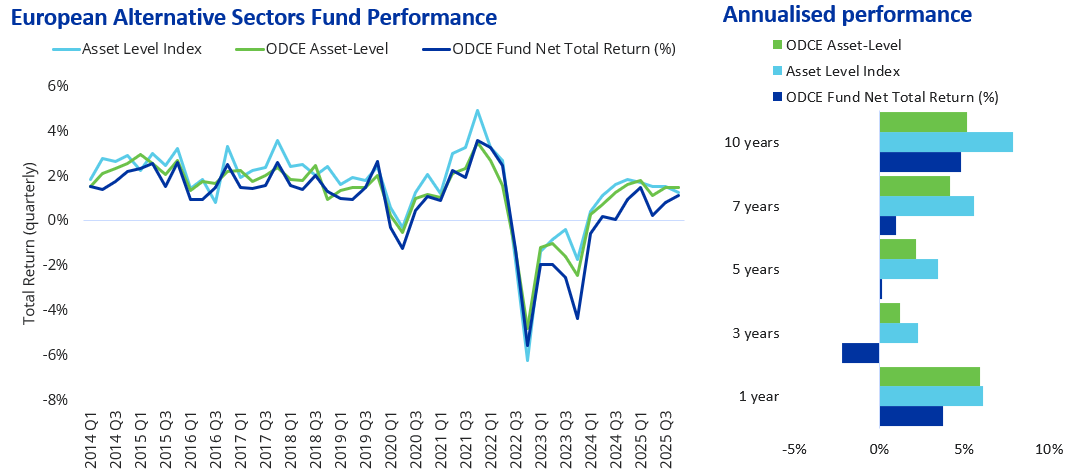
At asset level, the ODCE funds reported an unlevered 1.50% total return before fees and costs, which was 38bps above the ODCE Index net fund total return of 1.12% in Q4 2025. In the longer term, this is the case, however for individual periods like in 2022, the asset-level performance was lower than the fund return. The performance of the ODCE assets could also be compared with the wider Asset Level Index. In Q4 2025, the assets within the ODCE funds outperformed the assets in the wider Asset Level Index. However, in the longer term, the wider Asset Level Index outperformed.
Relative asset-level performance analysed
The new asset-level ODCE data set could be used for peer-to-peer comparison between an individual (ODCE) fund and the index, but also to understand the performance of the funds and the wider market. Segmentation at the country- and/or sector level¹ could be used to gain an understanding of the performance.
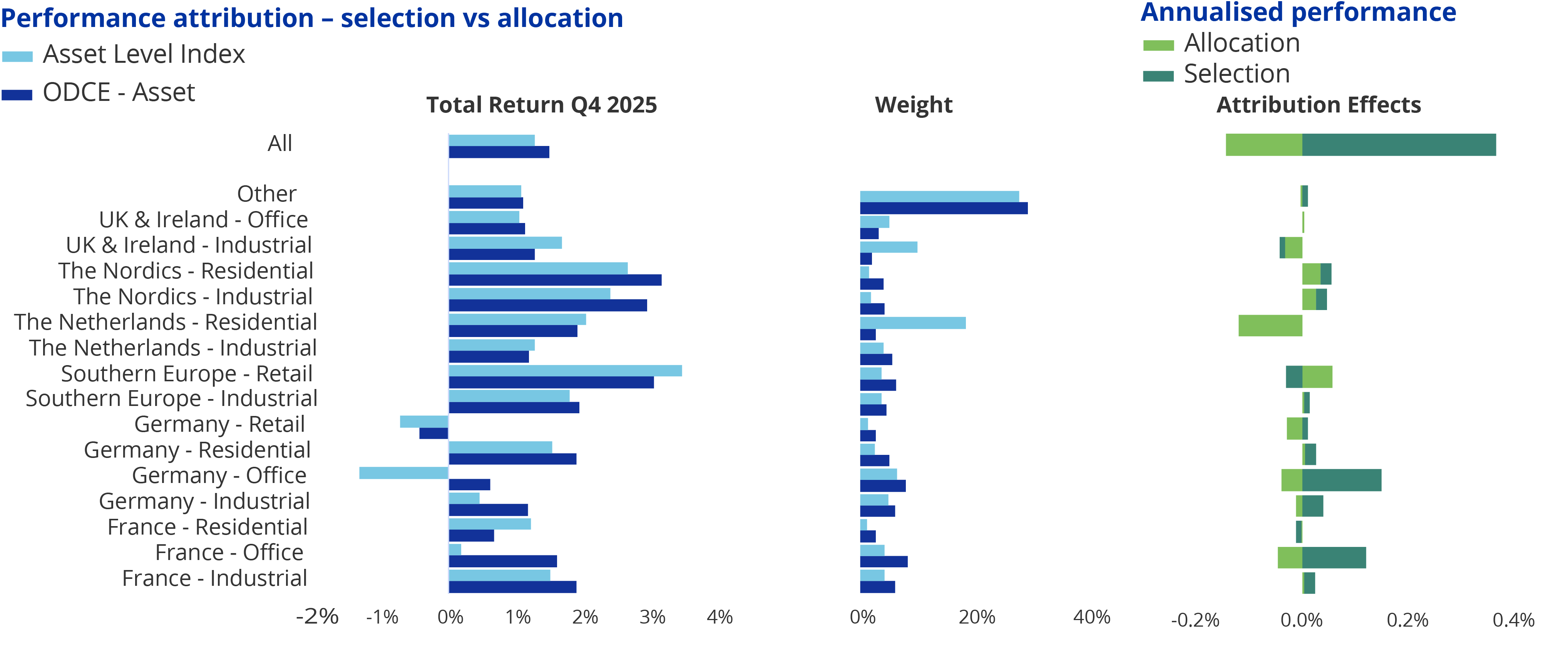
Attribution analyses allow members to understand the relative performance impact of allocation (what is the impact of strategic allocation decision) and asset-selection (picking the assets within the segment). Based on this, there is a clear impact of the selection within the main segments, which is driving the relative performance. When looking into the asset selection, the offices both in Germany and in France outperformed similar assets within the Asset Level Index. The overweight in French offices by ODCE funds, which underperformed the wider asset level index, resulted in a negative allocation impact. On the other hand, the underweight in Dutch residential, which outperformed the wider Asset Level Index, resulted in a negative allocation impact as well.
City level performance provides granular level insights
Beyond country and sector level insights, it is worthwhile to get insights on city level performance as well. The ODCE index results do include city-level performance for 27 cities across Europe. While in some countries the Q4 2025 returns across cities are somewhat aligned, like in Spain, in Germany, for instance, the performance at city level varies from -1.07% in Düsseldorf to 1.25% in Cologne. For several cities, data is available at the sector level, which provides an even more granular insight for research purposes. Even further granularity is available by the pick a location option, where a specific location could be picked, and a radius could be defined, showing performance data when the data confidentiality criteria are being met.
Drivers of performance between asset level and fund level performance made transparent
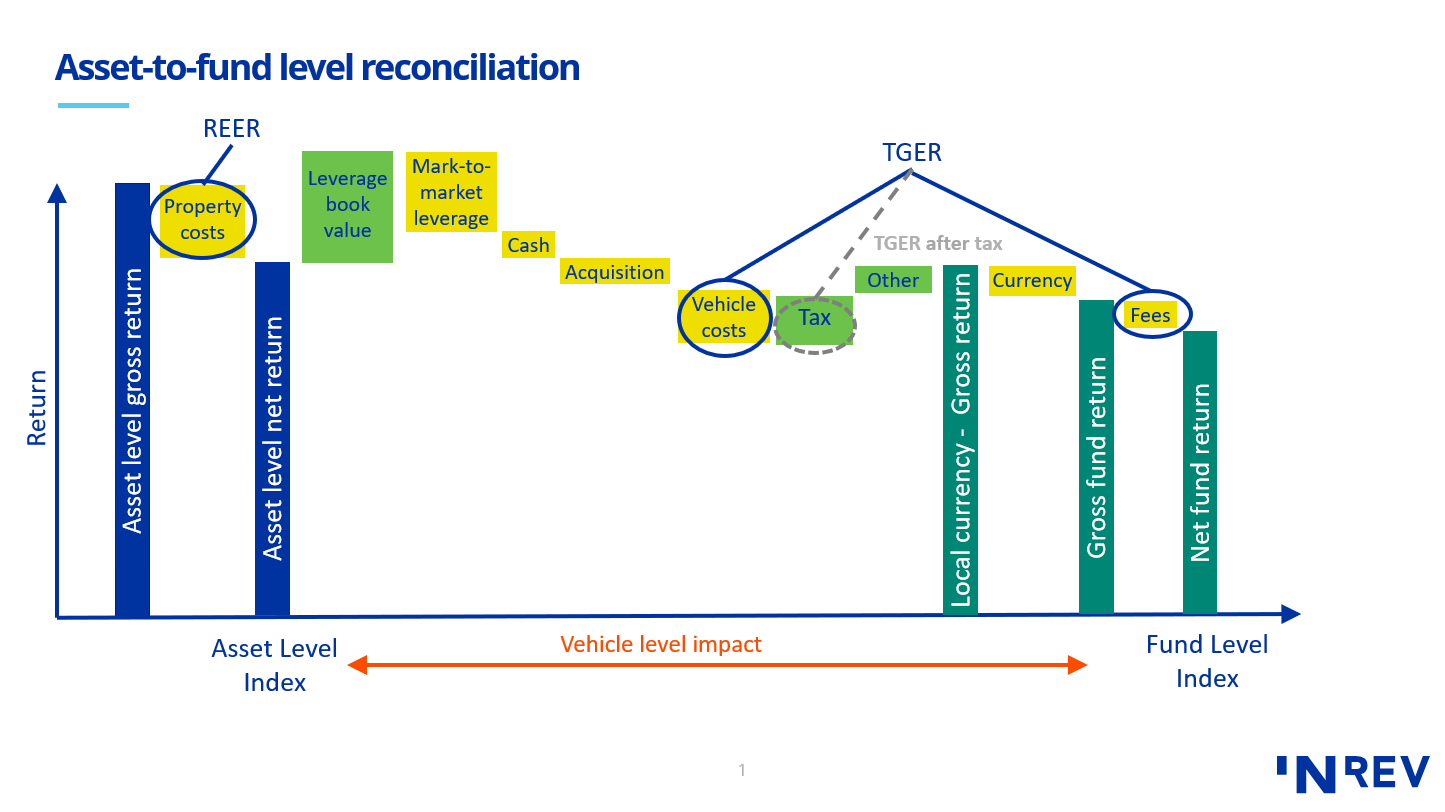
Asset-level performance is not the only driver of fund level performance. The fund performance is also being impacted by vehicle level components like vehicle costs and fees. To provide additional transparency on the costs and fees, in 2024, the first INREV ODCE management fees and terms study was released. However, that doesn’t explain the full difference, and therefore INREV has developed a methodology for asset-to-fund reconciliation together with the ODCE focus group. The methodology has been developed to provide insights into the impact of the main other components like leverage, acquisition costs, cash and tax but also the currency impact. The currency impact does allow to fully understand the impact of currency movement and hedging at the fund level and could, for instance, be used by investors in ODCE funds, which hedge their currency exposure themselves. The methodology has been developed and tested in a pilot by the ODCE fund managers.
If you would like to understand more about these new asset level index outputs or the wider index, feel free to reach out to the INREV Research team.
¹ Investment manager members are required to provide asset-level information to get access to the full version of the Asset Level Index Analysis Tool