
Environment
Addressing environmental impact with a focus on net zero carbon and nature, as well as broader ESG strategy implementation.
Implementing ESG Strategy Case Study
Related downloads
From Single-tenant Asset to Sustainable Multi-Tenant Office Landmark
Published on 28 Oct 2025 Share
Edmond de Rothschild REIM transformed a historic canal-side office in Amsterdam’s into a premium, sustainable multi-tenant workspace. The redevelopment upgraded energy performance from EPC label G to A through insulation, high-performance glazing, efficient HVAC systems, LED lighting, and PV panels, cutting carbon emissions by 59%. Fully pre-let before completion, the repositioned building achieved 76% higher total rent and exemplifies how targeted investment in sustainability can unlock long-term asset value in heritage locations.
Driving Sustainability in Retail: Redevelopment of Netto Market
Published on 28 Oct 2025 Share
The Netto Market redevelopment in Burhave transformed an outdated store into a modern, energy-efficient retail space. Developed by Slate Asset Management in partnership with Netto, the project exceeded Germany’s Building Energy Act standards, achieving a 378% compliance rate and an airtightness score of qE50 = 0.53.
A rooftop photovoltaic system with 178 panels now supplies 95% of the building’s electricity, while noise protection measures cut levels by up to 17 dB at night. Designed to meet DGNB Gold Certification, the scheme also integrates EV charging infrastructure and low-carbon materials. The result is a future-proof retail asset that combines operational efficiency with strong ESG performance, setting a benchmark for sustainable redevelopment in the sector.
NREP Urban Partners Case Study
Published on 29 Jan 2024 Share
The UN17 Village in Ørestad, Copenhagen, is a pioneering real estate development by NREP that integrates all 17 UN Sustainable Development Goals (SDGs) into its design. The project focuses on sustainability, including upcycled materials, renewable energy, water reuse, and healthy living spaces. Once completed in 2024, it will house around 1,100 residents in five buildings, featuring innovations like Denmark’s largest energy community and extensive rainwater collection. The initiative aims to set new standards for environmentally and socially responsible urban development.
COIMA: City Impact Fund - ESG Strategy Case Study
Published on 02 Feb 2021 Share
In July 2020, COIMA SGR received equity commitments of €400 million for the first close of the COIMA ESG City Impact Fund, the first urban regeneration ESG fund to be launched in Italy. With an open collaborative structure including co investments, partnership and financial leverage, the fund is targeting further equity raises up to €1 billion, to create a total investment capacity of over €4 billion.
Decarbonisation Strategy Case Study
Related downloads
CapMan – Scandinavia’s largest integrated solar roof
Published on 17 Dec 2025 Share
CapMan Real Estate replaced the ageing roof at Stationsparken with Scandinavia’s largest integrated solar roof, installing 10,534 photovoltaic tiles. The system generates 589,000 kWh of electricity per year, covering over 60% of the building’s demand, cutting CO₂ emissions by 60 tonnes annually, and reducing energy use by 37%. The project delivers €201,000 in yearly operating-cost savings and has an eight-year payback. The building is expected to achieve EPC A and DGNB Gold.
Jamestown – Rethinking carbon impact: Adaptive reuse outperforms new construction
Published on 17 Dec 2025 Share
Jamestown conducted Life Cycle Assessments for two office adaptive reuse projects in Amsterdam and Cologne, comparing their whole life-cycle carbon impact against hypothetical new-build scenarios. The analysis covered both upfront embodied carbon and use-stage emissions over a 50-year building lifespan. The study highlights that focusing only on operational carbon understates the true environmental benefits of reuse and reinforces the need for a whole life-cycle perspective in development decisions.
Bywater – Paradise Building
Published on 17 Dec 2025 Share
Paradise SE11 is a low-carbon office development in central London designed to meet RIBA 2030 and LETI benchmarks. The project adopts a mass-timber structure supported by a concrete core, achieving a substantial reduction in embodied carbon. Circularity measures include a demountable timber frame and non-permanent fire-protection boards, enabling future material recovery and storing a significant volume of CO₂. The fully electric building aligns with CRREM 2034 and achieves EPC A and BREEAM Excellent. Engagement with local students informed the façade design.
Ripple Residence: Denmark’s lowest-carbon residential building
Published on 18 Sep 2025 Share
Nrep’s Ripple Residence is a residential development in Copenhagen’s Nordhavn district that explores the commercial viability of low-carbon construction. The project features timber as the primary building material, targeted use of upcycled components, and an integrated energy system combining geothermal, solar, and smart controls. It achieves embodied emissions of 250 kgCO₂e/m² and operational emissions in line with CRREM pathways until 2050. Supported by DGNB certifications and green financing, the project shows that low-carbon housing can align with evolving regulatory requirements while remaining commercially competitive.
Net zero: Insights and experiences in Paris Proof residential renovations
Published on 18 Sep 2025 Share
a.s.r. real estate is advancing towards a net zero residential portfolio by 2045 through Paris Proof renovations. Guided by CRREM-aligned roadmaps, the Fund combines deep retrofits, renewable energy generation, and tenant engagement to reduce emissions and energy use. A successful pilot in Houten, now scaled across multiple dwellings, demonstrates how holistic, data-driven strategies can transform existing assets into future-proof, high-performance homes.
Amsterdam CBD’s first hybrid timber office building
Published on 18 Sep 2025 Share
The CubeHouse is Amsterdam’s first hybrid-timber office building, developed on the last available plot in the South-Axis CBD. Designed as the future Dutch headquarters for BNP Paribas and Arcadis, the project combines structural innovation with ambitious ESG goals. Using 13,000 m³ of sustainable timber storing 9,000 tonnes of CO₂, the building minimises embodied carbon while targeting Paris-proof performance, BREEAM Excellent and WELL Gold. With a rooftop garden, shared mobility hub and smart building systems, CubeHouse sets a new benchmark for sustainable workplaces in the Netherlands.
Amro Partners creates Salamanca’s first BREEAM Outstanding building
Published on 18 Sep 2025 Share
Amro Partners delivered Salamanca’s first BREEAM Outstanding student residence, balancing historic preservation with cutting-edge sustainability. The 170-bed scheme retained its early 1900s façade while introducing a fossil-free, high-performance building envelope. Achieving EPC ‘A’, Fitwel 3 Stars and WiredScore Platinum, it reduces operational carbon by 88% and brings embodied carbon close to 2030 LETI targets, setting a new benchmark for sustainable living in Spain.
Innocent energy neutral factory - Deerns Case Study
Published on 06 Feb 2024 Share
The case study details the development of Innocent Drinks’ energy-neutral factory in Rotterdam, designed by Deerns. The facility integrates sustainable features, including a solar park, wind turbines, and efficient energy systems, achieving BREEAM-NL Outstanding and WELL Platinum certifications. Producing 400 million bottles annually, it reduces transportation miles by 25% and CO₂ emissions by 10%. This innovative approach highlights effective collaboration and sustainability in industrial design.
Retail Park Malinas - Mitiska Case Study
Published on 15 Feb 2022 Share
The Malinas Retail Park in Mechelen, Belgium, developed by Mitiska REIM, is Europe’s first CO2-neutral retail park. Achieving BREEAM 'Excellent' certification, its sustainable features include solar panels generating 2.85 MWp, green façades, permeable paving, and rainwater management systems. The park also promotes biodiversity, creating 254 jobs and providing eco-friendly infrastructure like EV charging stations. Opened fully let in 2021, it reflects the demand for accessible, sustainable retail solutions.
Elithis Danube Tower - Catella Case Study
Published on 15 Feb 2022 Share
The Elithis Danube Tower in Strasbourg is the world’s first energy-positive residential building, generating more energy than it consumes through solar panels and smart design. Completed in 2018, this 17-story, 63-apartment tower emphasizes sustainability, affordability, and comfort, offering near-zero energy bills and reduced CO₂ emissions. Residents use a Smart Home App to monitor and optimize energy usage. The project demonstrates that sustainable construction can be cost-effective and scalable, inspiring plans for 100 similar towers by 2030.
CRREM Risk Assessment Reference Guide - V2 User manual for the CRREM Risk Assessment Tool V2
Published on 01 Sep 2023 Share
User manual for the CRREM Risk Assessment Tool V2: This Reference Guide accompanies the CRREM Carbon Risk Assessment Tool for the Global Commercial & Residential Real Estate Industry.
The guide provides an overall instruction on how the CRREM tool should be applied, as well as indepth guidance into the user input variables for the tool, user adjustable variables, default data underlying the tool and resulting output figures on property and portfolio level.
Net Zero Carbon retrofit in Dublin Offices
Published on 13 May 2025 Share
IPUT Real Estate redefined sustainable retrofit practice with the transformation of 25 North Wall Quay in Dublin. This landmark redevelopment delivered IPUT’s first net zero office, achieving a 60% reduction in embodied carbon and 70% energy savings while retaining 75% of the original structure. Completed in Q1 2025, the project demonstrates how circular economy principles and close occupier collaboration can meet ambitious environmental, operational, and wellness goals without demolition.
Nature Case Study
Related downloads
Nature-based solutions feasibility study & design guide by Longevity
Published on 28 May 2025 Share
Realterm engaged Longevity Partners to assess the feasibility of implementing Nature-based Solutions (NbS) across a number of assets in the Netherlands, in response to climate risks including drought, flooding, and soil degradation. The study evaluated green infrastructure options specific to each site, incorporating legislative, technical, and ecological considerations. Based on this analysis, Longevity Partners developed tailored NbS recommendations and a practical design guide. Initial measures implemented include rainwater reuse systems and biodiversity enhancements such as birdhouses and bee boxes. The initiative supports Realterm’s ESG+R strategy by strengthening asset-level climate resilience and aligning with emerging regulatory frameworks.
How one fund managed its BNG obligations directly and benefited a whole community - abrdn Case Study
Published on 18 Nov 2024 Share
abrdn's AIPUT faced challenges in meeting the UK’s Biodiversity Net Gain (BNG) requirements for its Heathrow developments. The solution involved creating a biodiversity bank on a 30-hectare greenfield site. This area, initially agricultural land, was converted into a habitat, generating BNG credits for use in the fund's developments. The project also contributed to carbon offsetting and community rewilding. Although market conditions led to a shift away from the BNG proposals, the model showed potential for future biodiversity and carbon credit initiatives within abrdn’s wider portfolio.
Biodiversity assessment across the portfolio - APG Case Study
Published on 13 Nov 2024 Share
APG implemented a biodiversity risk assessment across its global real estate portfolio to address biodiversity loss. This analysis, using data from leading conservation organisations, highlighted areas of protected habitats, priority species, and critical conservation needs. Conducting the analysis for APG’s Amsterdam office serves as an illustrative example of how these type of assessments can be of value, even in urbanised areas. Despite its urban nature, the region around Amsterdam demonstrates significant biodiversity value and conservation potential.The insights from the analysis help APG develop targeted conservation strategies and integrate biodiversity considerations into investment decisions.
Biodiversity Initiatives at Bourn Quarter - Savills Case Study
Published on 13 Nov 2024 Share
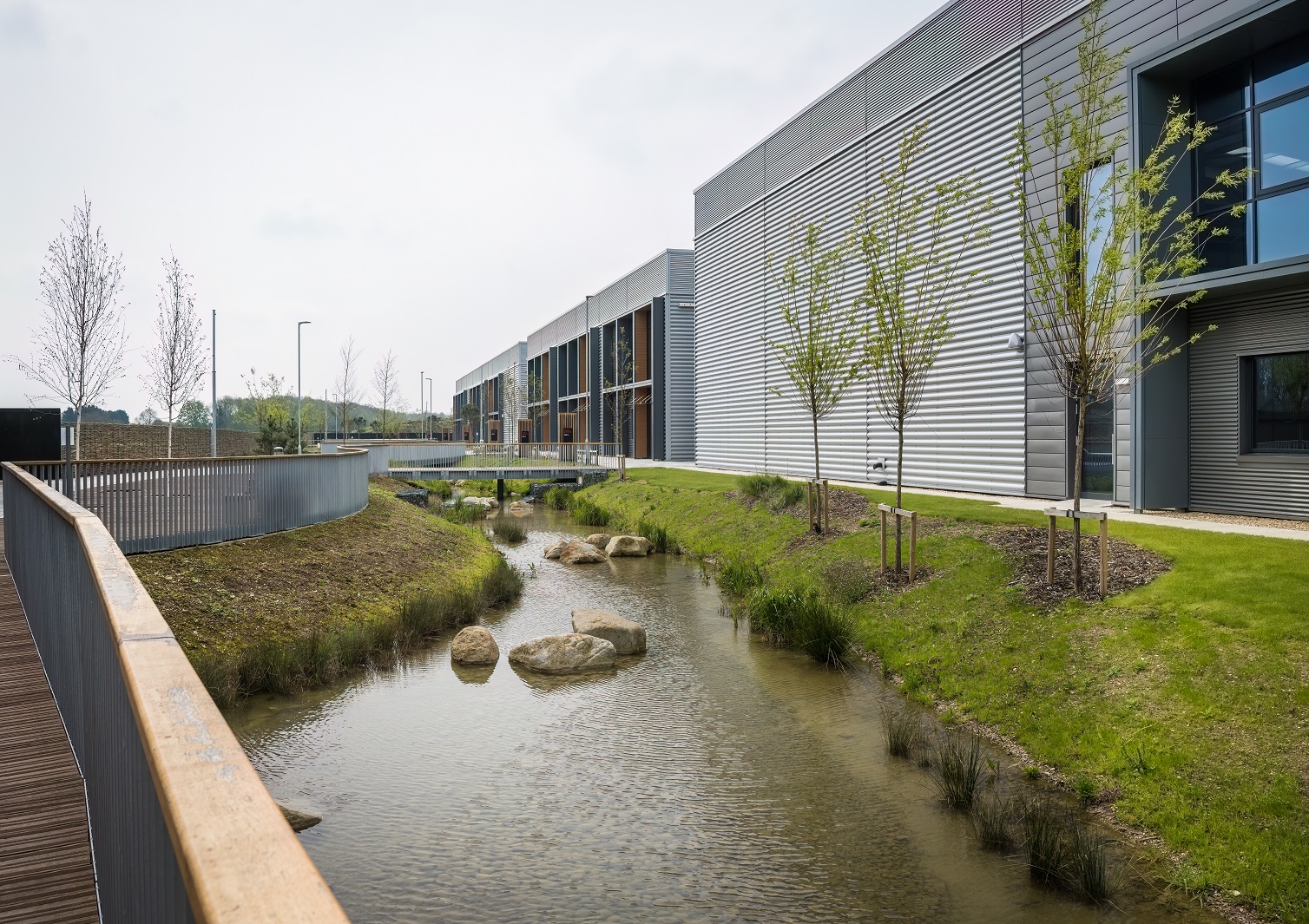
Bourn Quarter, a 25-acre business park, transformed a former WW2 airfield site with innovative biodiversity initiatives. These included insect hotels, bird boxes and over 2,500 native trees and shrubs. A sustainable urban drainage system supports local species and manages runoff. The site minimises light pollution to protect local wildlife like the Barbastelle bat. This green infrastructure, alongside wildflower seeding, has created a thriving natural habitat, enhancing both biodiversity and the area's aesthetic appeal.
Extension of a local biotope on an asset’s roof - KLP Case Study
Published on 13 Nov 2024 Share
With the construction of a new shopping center on a plot covered by grassland, KLP Eiendom wished to reduce the project’s negative impact on local biodiversity. KLP Eiendom's Fornebu S shopping center in Oslo incorporates a green roof that recreates a rare local habitat, "dry calcareous grassland," enhancing biodiversity. The roof consists of 84 native plant species and beehives and provides a vital “green corridor, helping to protect the local biotope after the conversion of significant natural land into a built environment. It mitigates physical climate risks by absorbing water during torrential rain, reducing stress on storm drains. The green roof helps keep the building cool during extreme heat. Furthermore, it enhances the visual appeal for residents in surrounding apartment buildings.
Physical climate risk
Related downloads
Link – Climate resilience-linked insurance renewal
Published on 17 Dec 2025 Share
Link invested HK$5 million in flood-resilience measures and engaged 22 insurers through a resilience-focused roadshow. A Sustainability-Linked Insurance model developed with AXA demonstrated a 10–20% potential reduction in flood losses. In 2025, Link achieved an 11.7% premium reduction, doubled water-damage sub-limits, secured two-year coverage, and negotiated an additional 7.5% performance-linked discount. Despite severe weather in 2025, claims decreased by 66% compared with 2023.
EU Taxonomy alignment supported by physical climate risk analysis - Edmond de Rothschild REIM case study
Published on 09 Dec 2025 Share
Edmond de Rothschild REIM assessed 16 logistics and industrial assets in the Netherlands and Germany to achieve EU Taxonomy alignment. With no EPC labels available for logistics areas, the team used BREEAM In Use energy ratings and Energy Performance Contracts to demonstrate energy performance. Physical climate risks were analysed through MunichRe’s risk scan and the Climate Effect Atlas. Asset level adaptation plans and external certification via DGBC and BREEAM v6.1 provided clear, verifiable assurance for investors.
Physical risk assessment of an office building with high exposure to water risk - Real I.S. Group case study
Published on 09 Dec 2025 Share
Real I.S. assessed the physical climate risks of an office building in Hamburg, located directly on the Elbe River - an area exposed to sea level rise and flooding. Using MunichRe’s Location Risk Intelligence tool and a detailed vulnerability assessment, the team evaluated how potential flood events could impact the building’s structure, systems and usability. Despite the high risk at the location, built-in protection systems such as dam barriers, flood protection doors, sealed windows and pumps resulted in a very low vulnerability rating, demonstrating strong asset-level resilience.
Future-proofing assets: Merging adaptation and mitigation under CAPEX constraints - Swiss Life Asset Managers case study
Published on 09 Dec 2025 Share
Swiss Life Asset Managers assessed the physical climate risks of a 1992 office building in Paris while operating under strict CAPEX limits. Using climate risk analyses from Deepki, Swiss Re and R4RE Batadapt, the team identified low cost resilience measures that aligned with an existing 5 million euro renovation plan. Ninety seven percent of adaptation actions also improved energy efficiency, avoiding additional spending. The project shows how combining adaptation and mitigation supports compliance with Décret Tertiaire and CRREM pathways while keeping investment within budget.