

Management fees and vehicle costs: trends for core funds
Management fees across core funds are falling and becoming more consistent. Vehicle costs tell a different story: averages remain stable, but substantially more dispersed.
- The relatively stable composition of the core funds sample provides a clearer view of fee and cost trends over time.
- Management fees have declined and become more consistent across core funds.
- Vehicle costs have remained broadly stable despite inflation and negative capital growth.
- Wide differences in vehicle costs highlight the importance of peer group analysis.
What do recent fee and cost trends tell us about core funds? The INREV Management Fees and Terms Study points to lower management fees, while vehicle costs remain more varied. The study examines fees and costs across European non-listed real estate vehicles, focusing on Total Global Expense Ratios (TGERs) and Real Estate Expense Ratios (REERs). Launched in 2007 and published annually in September or October, this year’s study includes 96 of the 375 vehicles that reported performance data for 2025.
Changes in the study sample mean year-on-year comparisons should be treated with some caution. However, the core sample has remained relatively consistent. A total of 61 funds provided data in each of the past three years, representing more than 80% of the core sample in each year. This provides a robust basis for tracking how fees and costs have evolved over time.
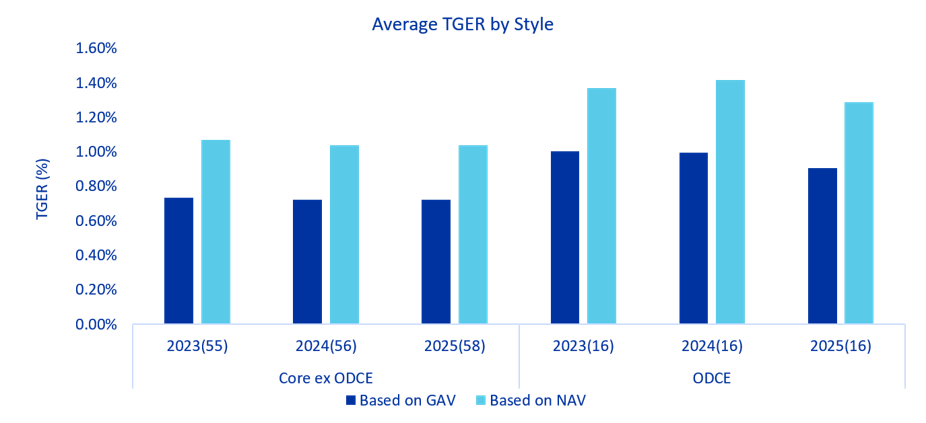
Across the past three reporting periods, TGERs for core funds excluding ODCE (core ex ODCE) have generally declined on both a gross asset value (GAV) and net asset value (NAV) basis, indicating an overall improvement in cost efficiency. ODCE funds show a similar trend, although their expense ratios remain consistently higher than those of the broader core universe. This reflects the added complexity of managing diversified portfolios across multiple countries and sectors.
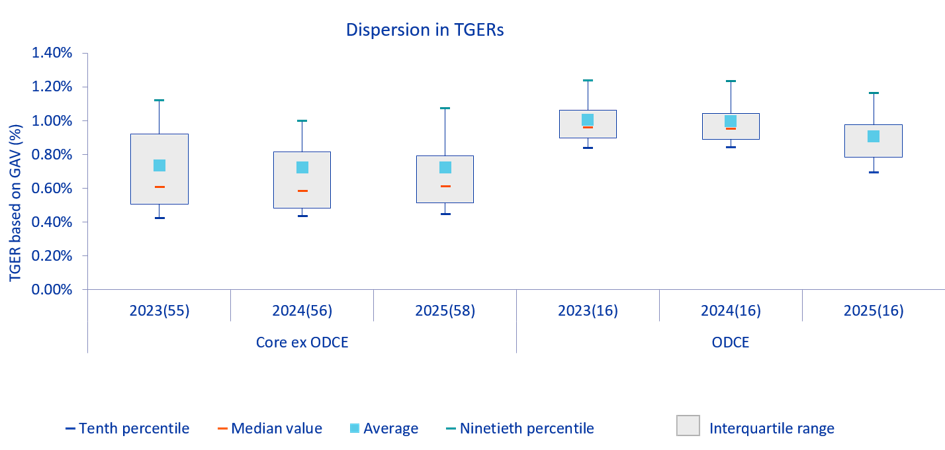
Core ex ODCE funds have consistently exhibited a broader range of expense outcomes, reflecting greater variation in fund size and investment strategies. ODCE funds, which have closely aligned investment strategies, have maintained a comparatively tighter dispersion. Over time, dispersion in TGER on a GAV basis, measured by the interquartile and interpercentile ranges, has remained broadly unchanged for ODCE funds. Amongst other core funds, however, the interquartile range has narrowed, indicating a shift to greater consistency in expense ratios over time.
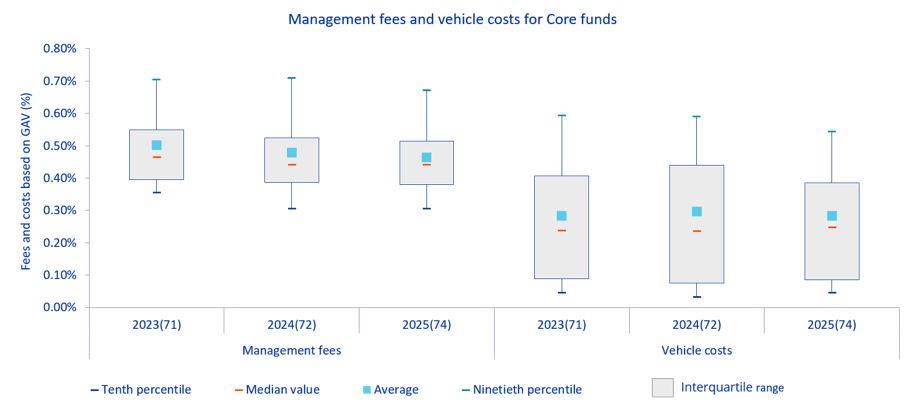
Management fees show an even clearer trend towards lower and more consistent fee levels. For core funds, average management fees declined from 0.50% in 2023 to 0.46% in 2025, while the dispersion of management fees also narrowed.
Vehicle costs present a different picture. Average costs have remained broadly stable, while their dispersion continues to be considerably wider than that of management fees. The stability is notable given both negative capital growth in 2023 and 2024, which could have increased expense ratios through the denominator effect, and inflationary pressures on underlying costs.
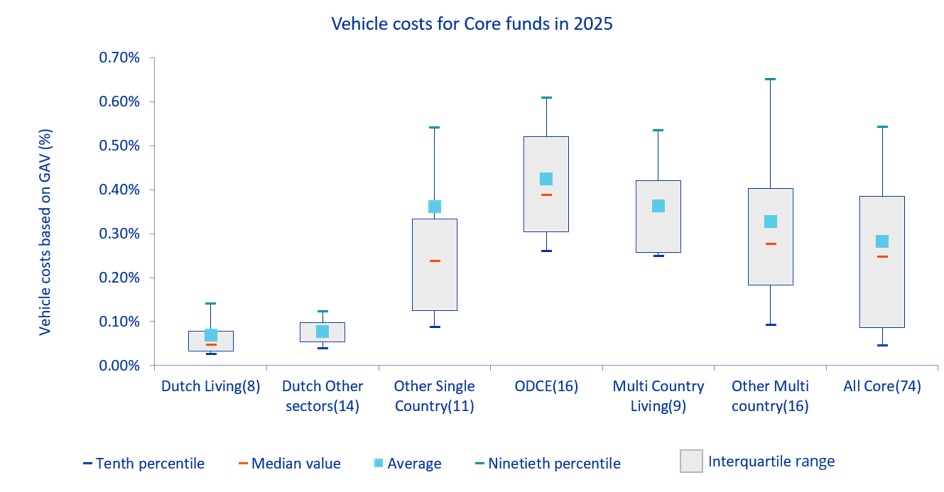
The wide dispersion in vehicle costs suggests that fund characteristics play an important role. Fund size and geographic strategy (market, single- or multi-country), in particular, can influence both the level and dispersion of costs.
Comparing funds with similar strategies brings these differences into sharper focus. Vehicle costs tend to vary less where investment strategies are more closely aligned. Multi-country funds generally report higher costs than single-country funds, reflecting higher professional services, administration and audit costs across jurisdictions. Debt arrangement and vehicle formation costs can add further fund-specific differences. For investors and managers, the implication is clear: peer group analysis provides a more meaningful basis for assessing vehicle costs. Comparing funds with similar geographic strategies and other characteristics helps separate wider market trends from the costs of individual fund structures.
INREV would like to thank all funds that contributed to the Management Fees and Terms Study. Alongside the main publication and dedicated ODCE analysis, INREV is exploring further insights for other peer groups. To find out more, contact Bert Teuben at bert.teuben@inrev.org.