

From transition risk to value creation: managing the next generation of real estate portfolios
Environmental sustainability and the journey to decarbonisation have been climbing up the real estate investment agenda for a decade, but the time for planning has now given way to the time for action. Kelly Harrison, a structural engineer and Director at international engineering practice, Whitby Wood, recently co-founded transition advisory company alpha. She tells IQ that the current state in Europe reflects the convergence of rapidly approaching regulatory deadlines and increasingly frequent climate extremes.
‘The approaching storm is not just influencing real estate policy, but also starting to affect occupational demand and capital flows. Everyone involved with a building wants to know that it will be resilient both in use and as an investment, and that brings up a lot of questions about how the asset is set to behave in the future, many of which relate to its design, construction, and internal systems. These are classic engineering questions as much as anything.’
For Kelly, the transition that investors now face comprises three intersecting elements: energy, climate and social change. ‘Up until now, the real estate industry has focused overwhelmingly on energy, but climate risks such as heat, flooding and water stress are becoming more acute, while changing patterns of mobility, technology and how people use buildings are creating another set of pressures. This implies that investors not only need to understand how buildings work for their users, but also the potential they have for modification and repurposing, based on their underlying characteristics.’ Kelly described a theoretical example of a provincial city centre building where the retail space on the lower levels is threatened by flood risk from a nearby river, the car parking at the middle levels is set to become redundant due to changes in transport availability, and the offices on the upper levels are insufficiently shaded with outdated cooling systems.
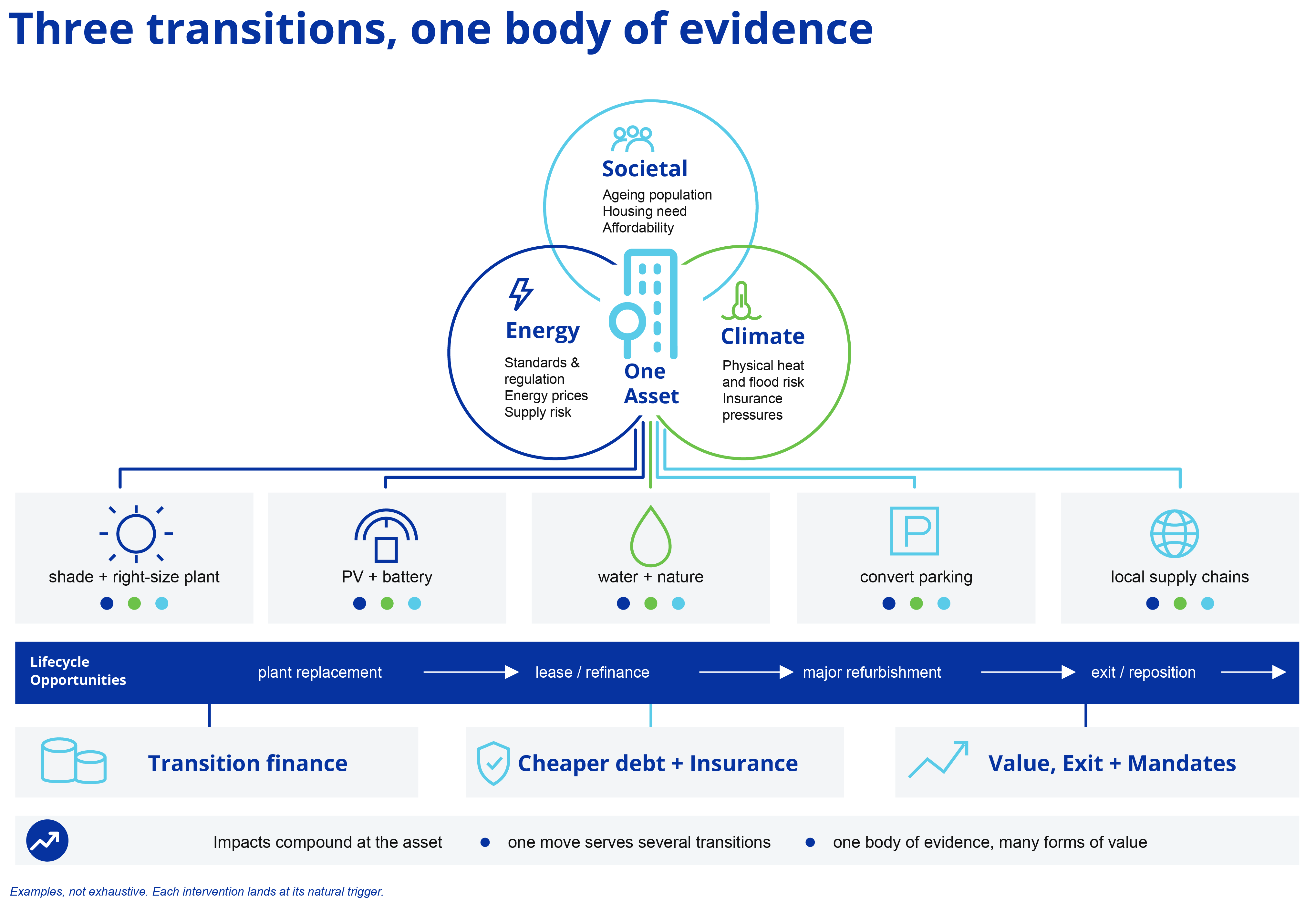
Source: alpha analysis 2026
‘Finding the best solution to this cocktail of issues requires a broad understanding of a range of engineering and construction possibilities. How can the car parking space be repurposed? Would residential be more profitable in this provincial centre than office use? What are the least carbon-intensive cooling technologies available for this space, and could power be generated on site? How likely is the local authority to introduce flood mitigation? Does the presence of water nearby offer cooling potential in the longer-term?’
‘The point isn't to solve each of these issues separately. The right intervention can respond to several at once, which is why understanding how the risks interact matters.’
All these factors need to be considered and their potential impacts balanced, taking into account both physical factors and the relevant financial aspects. Insurance costs for this building are likely to escalate given its climate susceptibilities, but there may also be the potential for obtaining transition finance (e.g. from the ECB) if suitable modifications are planned for. So, it’s not just about being aware of possible solutions from currently available technology, it’s also understanding how they will interact and what they mean for cost and value.
Those decisions also need to consider which action makes most sense in the asset lifecycle. Plant replacement, a lease event or refinancing, major refurbishment and eventual exit or repositioning can all provide natural opportunities to intervene.
This kind of transition-focused analysis needs to be integrated with the portfolio’s overall strategy, and can ultimately strengthen it. ‘This is all about how the world is changing and making sure that assets continue to be fit for purpose, something that is particularly crucial on exit,’ Kelly continues. ‘No doubt certain aspects of building design will already have been considered within existing strategic approaches, for example, those based on the megatrends expected to impact the asset class overall. But gaining an extra layer of asset-level insight can give investors a stronger basis for prioritising capex across the portfolio, particularly given the critical decision points investors are now facing.’
Property valuations provide an important baseline for asset-focused approaches to strategy, but Kelly argues that investors should also be aware of their limitations when thinking about transition. ‘Valuers are increasingly aware of the importance of environmental resilience, partly due to the efforts of bodies like INREV and ULI in highlighting the issue,’ she says, but she has some sympathy with the valuer’s position because their discipline is fundamentally evidence-based, while many transition risks and opportunities are forward-looking and may not yet be fully reflected in transaction data.
‘That means investors need to get ahead of the market evidence,’ she concludes. ‘When I attended London Climate Action Week in June, there was a clear sense among the tens of thousands of delegates that change is urgent, especially for buildings. The discomfort of repeated heatwaves this summer in the UK has only reinforced this belief. While the choices facing real estate owners can still be daunting, adding an extra engineering-oriented, asset-level layer of analysis to investment decisions can be a big help in moving things forward.’
Interested in learning more? Explore INREV's dedicated page on Environmental considerations in underwriting to understand how sustainability data impacts underwriting inputs and expected returns, or read INREV's research paper series on navigating physical climate risk. You can also find the ESG SDDS template to help you standardise the disclosure and reporting of ESG KPIs.